 amigo
Barcelona festivals calendar: what happens when, month by month
Barcelona's calendar is built around a handful of fixed dates that the whole city observes and a set of big music festivals that fill every hotel. Knowing which is which helps you decide when to come, and when prices will be at their worst.
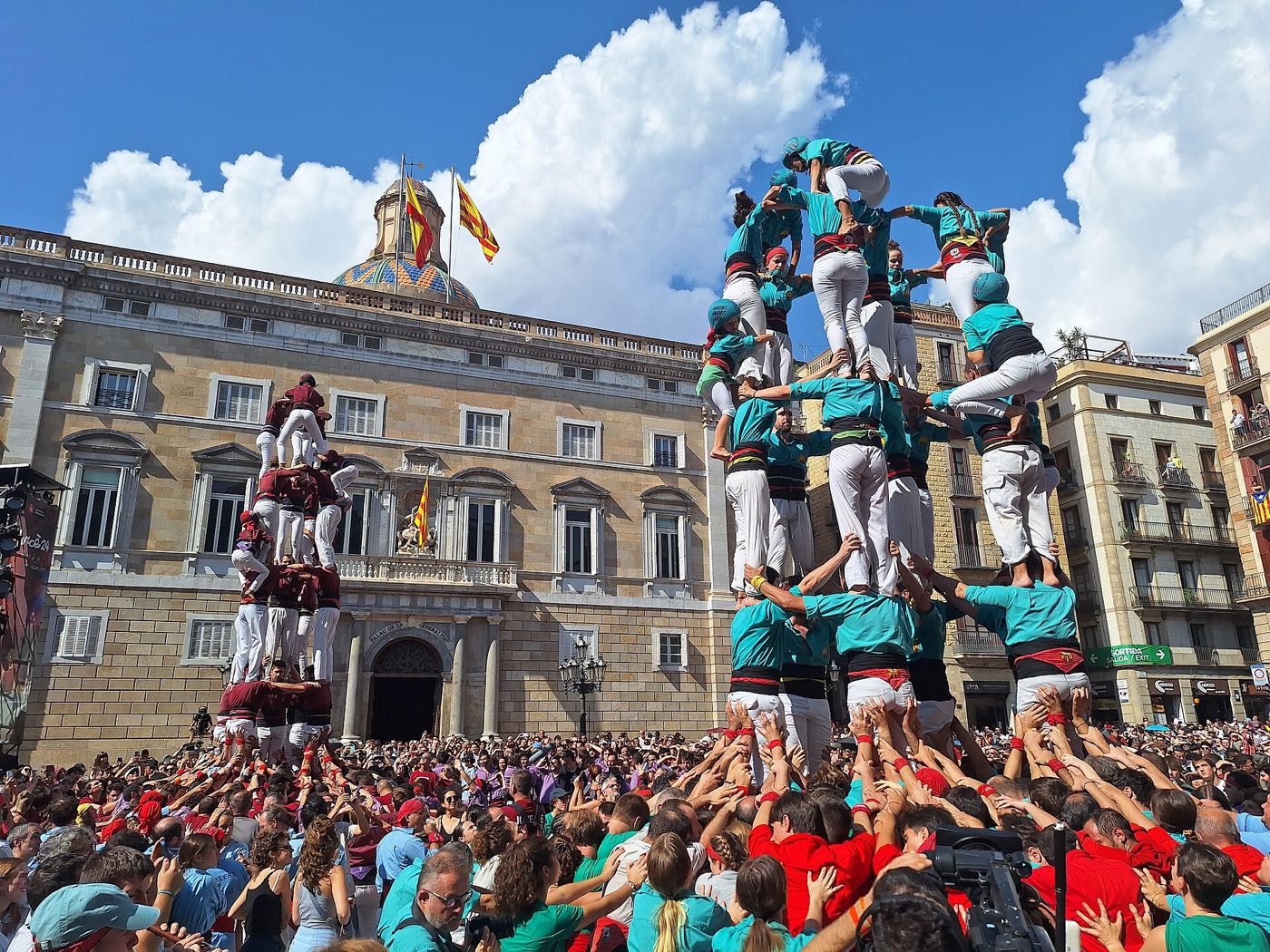
Traditional Catalan festivals share a vocabulary. Castellers build human towers eight or nine storeys high. Gegants are giant papier-mâché figures that dance through the streets. A correfoc is a fire run, in which costumed devils chase the crowd with spinning fireworks. Wear old cotton clothes and cover your head if you want to join that one.
January to March
The year opens with the Three Kings parade on the evening of 5 January, when the Kings arrive by boat at the port and ride through the centre throwing sweets. It is the main present-giving day for Spanish children and the streets are packed.
In mid-February the city marks its winter festival, Santa Eulàlia, around the saint's day on the 12th, with giants, human towers and fire runs in the Gothic Quarter. It is a smaller, more local version of La Mercè. Carnival follows in the week before Lent; Barcelona's own celebrations are modest, and the big parades are down the coast in Sitges.
Sant Jordi: 23 April
Sant Jordi is the best day of the year to be in Barcelona. It is the feast of Saint George, patron of Catalonia, and the custom is to give a book and a rose. The centre fills with hundreds of book and flower stalls, above all along Passeig de Gràcia, Rambla de Catalunya and La Rambla, and authors sign for hours.
The date never moves; in 2027 it falls on a Friday. It is a normal working day, so shops and museums are open, and Casa Batlló usually covers its façade in roses. Go in the morning, since by late afternoon the central streets are shoulder to shoulder.
Primavera Sound: early June
Primavera Sound is the city's biggest music festival and one of the most important in Europe for indie, pop and electronic music. It takes place at the Parc del Fòrum, a concrete seafront site at the north-east end of the city, on the L4 metro.
The 2027 edition, the festival's 25th anniversary, has been announced for 2 to 6 June 2027. The main festival days at the Fòrum are Thursday 3, Friday 4 and Saturday 5 June, with a free opening day on the Wednesday and a closing electronic party on the Sunday. Music runs until dawn. Hotel prices across the city rise sharply that week, so book early whether or not you are going.
Sónar: mid-June
Sónar is the electronic and digital-culture festival, running since 1994, split into a daytime programme and the much larger Sónar by Night. The festival has confirmed 17, 18 and 19 June 2027, with the night events on the Friday and Saturday at Fira Gran Via in L'Hospitalet. Organisers have said the daytime programme will return to a central waterfront location. Dozens of unofficial parties, known collectively as Off Sónar, take over clubs and hotel terraces the same week.
Sant Joan: night of 23 June
The shortest night of the year is the loudest. On the eve of Sant Joan, the 23rd, the whole of Catalonia lights bonfires, lets off fireworks and firecrackers until sunrise and eats coca, a flat sweet bread topped with candied fruit, with cava.
In Barcelona tens of thousands of people spend the night on the beaches. It is good-natured and chaotic. The metro runs through the night, the 24th is a public holiday with most shops shut, and the beaches are closed for cleaning on the morning after. If you dislike bangs, this is the night to be elsewhere. In 2027 the eve falls on a Wednesday.
July and August
July brings the Grec, the city's summer festival of theatre, dance and music, centred on the open-air amphitheatre on Montjuïc, and Pride Barcelona, usually in the middle of the month, with a parade and concerts.
The Festa Major de Gràcia is the best of the neighbourhood festivals and runs from 15 to 21 August every year. Residents spend months building decorations from recycled materials and then roof entire streets with them, each on a different theme, competing for a prize. In 2026, 23 streets and squares took part. There are free concerts on every corner, communal dinners, human towers and a closing fire run. Go once by day to see the decorations properly and once at night for the party. Many of the same people then move to the Festa Major de Sants, which follows straight afterwards.
La Mercè: around 24 September
La Mercè is Barcelona's own festival, in honour of its patron, the Virgin of Mercy, whose feast day on 24 September is a city public holiday. The programme spreads over four or five days around that date. In 2026 it ran from 23 to 27 September; the 2027 programme had not been published at the time of writing, but the 24th falls on a Friday.
Everything is free. Expect the parade of giants, human towers in Plaça de Sant Jaume, a huge correfoc, projections on public buildings, a wine and cava fair, and several nights of open-air concerts across the city, ending with a fireworks display set to music. Many museums open free on the 24th. It is the single best time to see Catalan popular culture in one go, and the weather is usually still warm enough to swim.
Christmas markets and the turn of the year
The Fira de Santa Llúcia, in front of the Cathedral, has been held since 1786 and is the city's main Christmas market. It usually opens in the last days of November and closes on 23 December; the 2025 edition ran from 28 November to 23 December and the same dates were listed for 2026. The stalls sell nativity figures, moss, mistletoe, the caganer and the tió de Nadal, the log that Catalan children beat on Christmas Eve to make it deliver presents.
A second market, the Fira de Nadal, sets up beside the Sagrada Família over roughly the same weeks. Christmas lights stay on until the Kings arrive on 5 January. Note that 25 and 26 December and 1 and 6 January are public holidays, with most shops and many restaurants closed.
Planning around the calendar
A few rules of thumb.
- Cheapest and calmest: January to early March, and November.
- Best weather with events: late April to mid-June, and September.
- Most expensive weeks: Primavera Sound, Sónar, late February or early March during the Mobile World Congress trade fair, and all of August.
- Always confirm dates on the official festival sites before booking flights, since programmes are often published only a few weeks ahead.