Passeig de Gràcia
- Address
- Passeig de Gràcia, 08007 Barcelona
- Metro
- Passeig de Gràcia (L2, L3, L4) or Diagonal (L3, L5)
- Price
- Free to walk; house museums charge separately
- Links
- Open map
Passeig de Gràcia began as the country road linking walled Barcelona to the separate village of Gràcia. When the city burst its walls in the 19th century and the Eixample grid was laid out, this became the address the industrial bourgeoisie wanted, and they competed to out-build each other. The result is a broad, tree-lined boulevard a little over a kilometre long where the architecture is the attraction and the shops are the excuse.
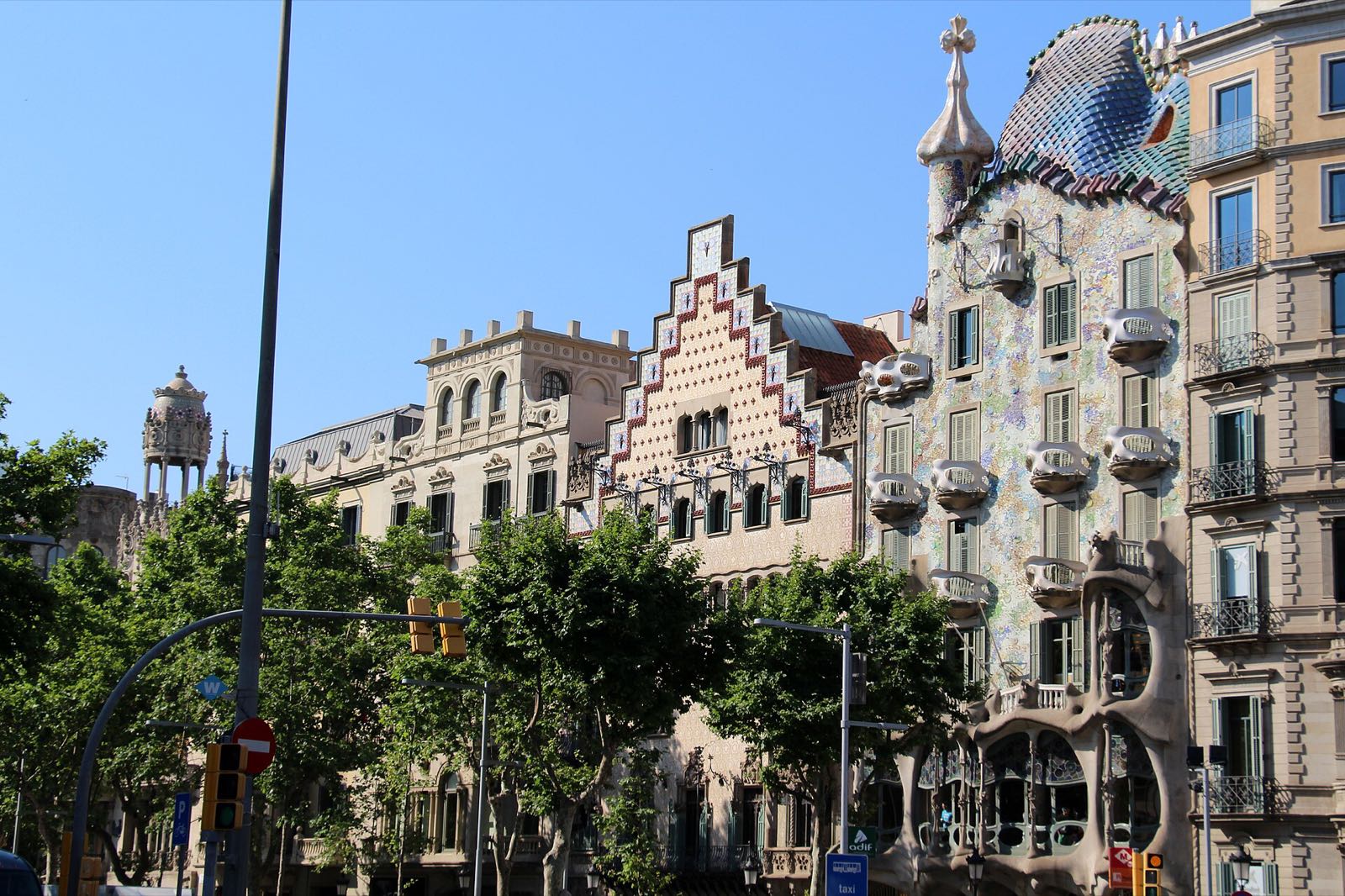
The essential stretch is the block between Carrer del Consell de Cent and Carrer d'Aragó, known as the Illa de la Discòrdia, the Block of Discord. Three rival architects built three houses almost side by side within a few years of each other. Lluís Domènech i Montaner's Casa Lleó Morera stands on the corner, with its florid stone balconies. Josep Puig i Cadafalch's Casa Amatller has a stepped Flemish gable and a ground floor that still sells chocolate. Next door is Gaudí's Casa Batlló, with its bone-like columns and scaled roof. Seeing them together explains Modernisme better than any museum label.
Three blocks further up, on the corner of Carrer de Provença, is La Pedrera, Gaudí's last private commission, all rippling stone and wrought-iron seaweed. Both Gaudí houses need timed tickets booked ahead. Casa Amatller also takes visitors, with tickets from around €19 in 2026, and is far quieter. Casa Lleó Morera has been open only intermittently, so admire it from the pavement.
Look down and up as you go. The hexagonal paving tiles under your feet, with their sea-creature relief, are a Gaudí design originally made for interiors. The 32 ornate iron lamp posts with tiled benches wrapped around their bases were designed by Pere Falqués in 1906. Above the shopfronts, almost every building has a carved doorway, a stained-glass gallery or a tiled cornice worth a second look.
The shopping is the high-end kind: the international luxury names cluster between Aragó and Diagonal, with Spanish chains towards Plaça de Catalunya. Near the top, the Palau Robert has free exhibitions and a small garden that makes a good pause.
For a visit, start at Plaça de Catalunya and walk uphill, crossing the road at least once, since each side shows you the other's façades. Half an hour covers it without stops. Come back after dusk: Casa Batlló and La Pedrera are both lit, and the pavements are calmer.
A word on eating. The terraces on the avenue itself charge for the address. Rambla de Catalunya, one block west, and the cross streets have better food at fairer prices; see our restaurants picks. At the top, the avenue narrows into the old village of Gràcia, a different and much more local world.
Why go
- Architecture. Three masterpieces by three rival Modernista architects on a single block.
- Free. The best of it is the façades, and they cost nothing.
- Details. Gaudí's paving tiles and Falqués's bench lamp posts line the whole route.
- Night walk. The lit façades after dark are worth a second visit.
 Keep in mind
- Interiors cost. Casa Batlló and La Pedrera are among the priciest tickets in town and need booking.
- Tourist pricing. Cafés and terraces on the avenue itself are poor value.
- Crowds. The pavement outside Casa Batlló is jammed from mid-morning.
- Pickpockets. Busy crossings and the metro entrances are known working spots.